Code is not text. It’s a living, breathing structure.
That’s the seismic realization dawning in the AI-assisted development world, and it’s coming with a hefty price tag attached. For one developer, a casual week of prodding his AI coding assistant resulted in a staggering 75% of his monthly API budget vaporizing. The kicker? Nothing about his workflow had changed. This isn’t some abstract future scenario; it’s a stark present-day problem, a tax on our ambition to build smarter, faster.
The Confusion Tax: More Code, Less Clarity
We’ve all been there. You ask your AI a seemingly simple question, like “how does my authentication middleware function?” and the response often involves dumping entire files – sometimes dozens, hundreds of lines of code – into the prompt. This is the developer’s version of shouting a request across a crowded stadium and expecting a whispered answer. The AI drowns in irrelevant data, hallucinating wildly and, crucially, costing you a fortune in tokens. The original article coins this the Confusion Tax, and it’s a brilliant, if painful, descriptor for this inefficient, bloat-ridden approach.
Traditional retrieval-augmented generation (RAG) methods treat code like a dusty old book, scanning lines without truly grokking the complex relationships between functions, classes, and modules. It sees text, not the dynamic, interconnected organism that a codebase truly is.
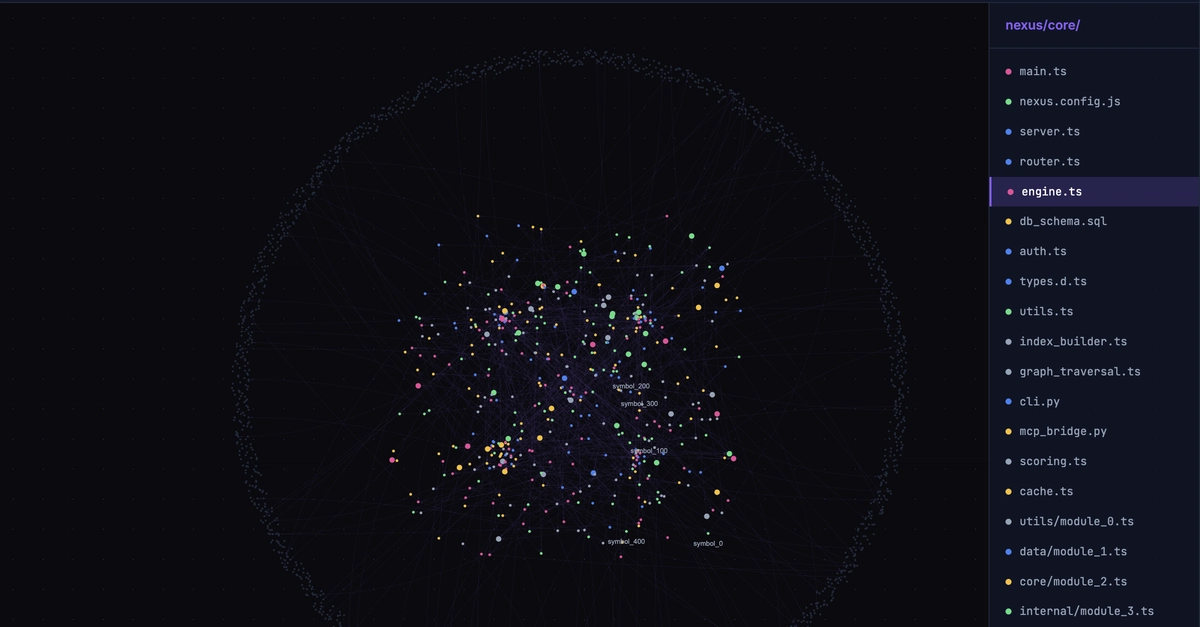
But here’s the electrifying part: every codebase is a directed graph. Functions call functions. Classes inherit from classes. Modules import from other modules. This inherent structure is the secret sauce that has been largely ignored.
Unlocking Surgical Context: The Graph Revolution
Imagine instead of a firehose of code, you receive only the exact branches and leaves needed to answer your question. That’s the paradigm shift Nexus-Graph brings. Instead of entire files, it delivers a k-step neighborhood traversal from an anchor node. Think of it like a super-powered truffle pig, sniffing out precisely the relevant pieces of code. Need to understand the auth middleware? Nexus-Graph hunts down the function itself, the direct functions it calls, and any critical types or interfaces it depends on. It’s context, delivered with surgical precision.
Nexus-Graph is a local-first code intelligence engine that doesn’t just look at code; it parses it into a directed symbol graph. It then serves this intelligently curated context to AI assistants using the Model Context Protocol (MCP), a standard embraced by major players like Claude Code, Cursor, and Gemini. This isn’t just an incremental improvement; it feels like the foundational plumbing for a new era of AI-powered development.
How Nexus-Graph Builds the Future
The process is elegant in its simplicity and powerful in its execution. First, Indexing: Nexus walks your project, parsing every relevant file (.py, .ts, .js, etc.) into a detailed graph of symbols and their relationships, all stored efficiently in SQLite. The schema itself is a revelation, clearly defining symbols like functions and classes, and the directed edges that connect them – imports, calls, extends, implements. It’s a blueprint of your entire development universe.
Next, Query: When your AI assistant needs context, Nexus doesn’t just perform a keyword search. It finds anchor symbols, then performs a breadth-first search traversal of the graph up to a specified k steps. Nodes are scored not just by proximity, but by recency – recently edited files get a boost. Crucially, it fills a token budget greedily, prioritizing full bodies, then definitions, before dropping less critical elements. This is context optimization at its finest.
Finally, Serve: The results are then fed back to the AI via MCP. The impact is dramatic. We’re talking about a 70% reduction in tokens per query, context blocks that are 5–10x smaller than traditional file dumps, and indexing speeds that can handle over 1,000 files in under 15 seconds. Queries themselves? Sub-100ms on an indexed project. This is performance that translates directly into saved time and money.
And for the open-source faithful, this entire system is MIT licensed and available on GitHub. Installation is as simple as an npm install -g @costline/nexus-graph, followed by a quick nexus-graph index --project . and nexus-graph server --project .. Wire it into your favorite AI tool (like Claude Code), and watch your token meter transform from a frantic spin to a gentle hum.
My Unique Insight: The Graph as AI’s Universal Translator
While the technical breakdown is impressive, what truly excites me is the underlying principle: Nexus-Graph isn’t just solving a token problem; it’s building a universal translator for AI. For years, we’ve treated code like unstructured text, forcing AI to learn our human conventions through brute force. But code has structure, a syntax of relationships as fundamental as natural language. By exposing this latent graph structure, Nexus-Graph provides AI with a conceptual map, allowing it to navigate and understand code with the intuition of a seasoned developer, not the clumsy guesswork of a lexicographer.
This move from a document-centric to a graph-centric approach for AI code context isn’t just efficient; it’s a fundamental platform shift. It’s akin to the jump from punch cards to high-level programming languages – a change in abstraction that unlocks entirely new possibilities. We’re finally speaking AI’s language of relationships, and the results are breathtaking.
Why Does This Matter for Developers?
This isn’t just about saving a few bucks on API calls, though that’s a very welcome byproduct. This is about reclaiming developer sanity. Imagine AI assistants that don’t just autocomplete code but truly understand your project’s architecture. Assistants that can pinpoint bugs with uncanny accuracy because they grasp the causal chain of events. Assistants that can refactor complex systems with confidence because they see the complex web of dependencies. Nexus-Graph’s approach makes these scenarios not just possible, but probable. It’s democratizing sophisticated AI code understanding, making it accessible to everyone.
🧬 Related Insights
- Read more: Linux ‘Copy Fail’ Exploit: Kernel Patches Race Against Active Exploitation
- Read more: BeagleV Ahead’s HDMI Breakthrough on Linux 7.1: RISC-V Wakes Up, Barely
Frequently Asked Questions
What does Nexus-Graph actually do? Nexus-Graph parses your codebase into a directed graph of symbols and their relationships. This graph is then used to provide highly relevant, token-efficient context to AI assistants when they answer questions or help with coding tasks.
How much does Nexus-Graph cost? Nexus-Graph is open-source and MIT licensed, meaning it’s free to use. The primary cost savings come from significantly reducing the number of tokens your AI assistant consumes per query, thereby lowering your AI API bills.
Will Nexus-Graph replace my IDE? No, Nexus-Graph is designed to enhance your existing development tools and IDEs by providing smarter context to AI assistants integrated within them. It’s a powerful add-on, not a replacement for your primary coding environment.