The hum of a laptop fan, the glow of a screen, and the ever-present anxiety of data leakage. For developers working in sensitive environments – banks, defense contractors, even just on a borrowed machine – the idea of an AI coding assistant has been, until now, a non-starter. Cloud dependency meant a hard no for airgapped systems and privacy-conscious projects. But here’s the thing: what if your AI coding copilot lived on a USB stick?
That’s precisely the audacious vision behind code-stick, a new open-source project that’s more than just a clever hack; it’s a potential paradigm shift for developers who can’t afford to send their code anywhere but their local machine. Think Claude Code, but untethered. Completely offline. On any laptop. Without leaving a trace.
Plugging Into Privacy: The code-stick Solution
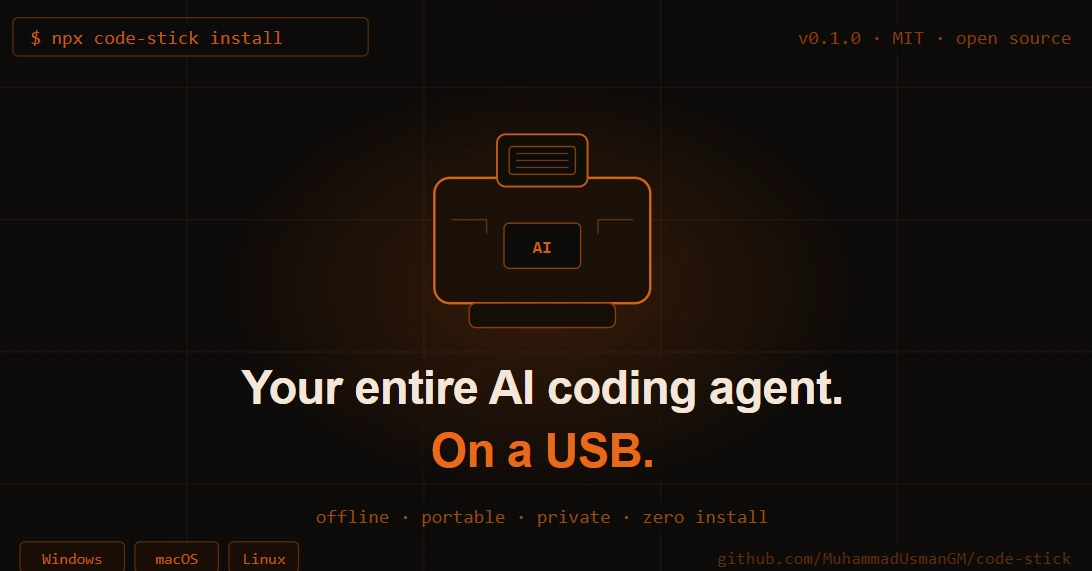
Muhammad Usman, the creator, distilled a complex need into a remarkably elegant solution. The concept is deceptively simple: install a command-line interface (npx code-stick install) on your machine, select a local LLM (options include Qwen2.5-Coder, DeepSeek-Coder, CodeGemma, and Phi-3), and everything – the binaries for opencode, Ollama, and the model weights themselves – gets housed directly on the USB drive. Three simple launchers (start-windows.bat, start-mac.command, start-linux.sh) sit at the root of the stick.
Plug it into any compatible machine, run the launcher, and boom: you’ve got a fully functional AI coding agent listening on 127.0.0.1. The critical detail? When you’re done, you simply quit the application. The Ollama process is killed, and when you yank the USB, there’s literally nothing left behind on the host system. No lingering processes, no temporary files, no digital footprint. This is the kind of clean execution that corporate IT departments dream of.
You get file editing, multi-step tasks, and tool use — running entirely on the stick against a local model. No internet. No installs. Nothing left on the host when you unplug.
Where Does This Actually Matter?
Usman rightly identifies three core scenarios where code-stick isn’t just convenient, but essential:
- Airgapped Environments: This is the obvious big one. High-security sectors like finance, healthcare, and defense operate under strict rules that prohibit external network connections or software installations. Code-stick sidesteps these restrictions entirely.
- Shared or Borrowed Machines: Imagine a student on a university lab computer, or a developer working on a client’s laptop. The need to keep the host environment pristine is paramount. code-stick makes AI-assisted coding feasible without any risk of contaminating the host.
- Privacy-Sensitive Code: For developers working under strict NDAs or with proprietary codebases, uploading snippets to a third-party AI service is a non-starter, legally and ethically. Running the AI locally, on a portable device, offers a crucial layer of data control.
A Bold Move, But Is It Sustainable?
From a market perspective, this is fascinating. The AI tooling space is saturated with cloud-first solutions. Companies are betting big on services that require constant connectivity and subscription fees. code-stick, being MIT licensed and entirely offline, directly challenges that model. It’s a potent reminder that the underlying technology – large language models – can be democratized and deployed in ways that bypass the prevailing SaaS dogma.
The real hurdle, as always with open-source projects, will be adoption and long-term maintenance. v0.1.0 is described as “early but working,