So, your French SaaS company needs an AI. Great. The easy part’s over. Now comes the real headache: which digital oracle do you empower with your clients’ most sensitive information? Forget the academic debates about model architectures for a second. This isn’t some abstract R&D exercise anymore; it’s a product decision with teeth, and the implications for real people—your customers—are immense.
Because when you hook your application up to one of these behemoths—Mistral, OpenAI, Anthropic, Meta—you’re not just sending prompts into the digital ether. You’re potentially handing over the keys to the kingdom: internal documents, personal user data, even the whispers of user queries that can reveal more than you’d ever want a foreign entity to know. This isn’t just code; it’s a political and legal minefield, disguised as convenient APIs.
The Great Data Debate: Where Do Your Bits Go?
Think about it. The content of documents your AI analyzes, the personal details of your users—emails, profiles, conversations—even the very questions they ask. All of it can travel across borders, landing on servers in jurisdictions with entirely different legal frameworks and privacy expectations. The supplier’s terms of use, their data hosting location, the legal reach of their home country—these aren’t minor details. They’re potential tripwires for data breaches and regulatory nightmares.
“Quand on intègre un LLM dans une application, on envoie potentiellement à un tiers : Le contenu des documents internes que l’IA va analyser - Les données personnelles des utilisateurs… Les questions posées par les utilisateurs…”
This is precisely why the LLM choice is, and always will be, a political and legal decision as much as a technical one. Especially for French businesses.
Mistral AI: The Homegrown Hero?
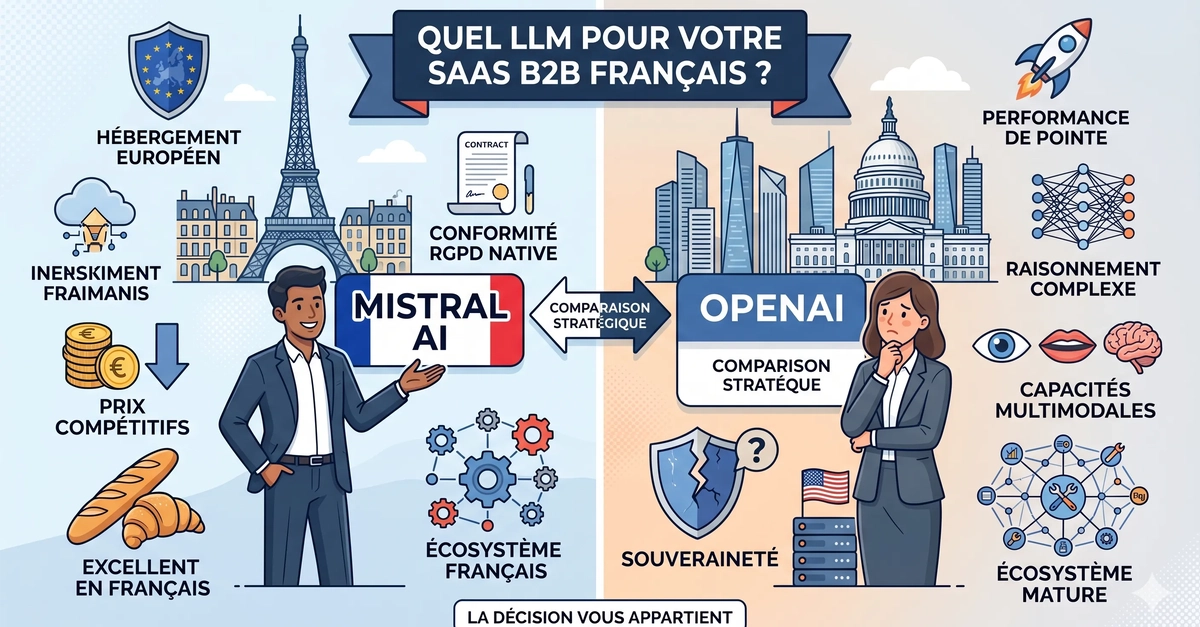
Mistral AI, born in Paris in 2023 from the minds of ex-DeepMind and Meta luminaries, positions itself as the European champion. Their pitch is compelling for a French TPE or PME building B2B SaaS. European hosting is a big win, particularly for clients nervous about the US CLOUD Act. They offer both open-source models you can host yourself (if you have the GPU farm and the nerve) and proprietary ones that still play nice with European data regulations. Crucially, they’re signing DPAs (Data Processing Agreements) and guaranteeing your data won’t be used to retrain their models. For companies catering to French government entities, or those hyper-aware of data sovereignty, Mistral looks like the obvious, compliant choice.
OpenAI: The Performance Powerhouse (with Caveats)
OpenAI, the company that brought ChatGPT to the masses, offers models like GPT-4o and GPT-4-Turbo that still dominate the raw performance charts. Their ecosystem is mature, packed with features. But here’s the rub: their primary hosting is in the US. While Azure OpenAI Service offers EU hosting options, it’s an extra layer of configuration and requires dedicated contracts. And even then, the specter of US legal reach looms. If bleeding-edge performance is your only concern, and you’re willing to accept the associated risks for your clients’ data, OpenAI might be your pick. For rapid POCs, sure. For long-term, sensitive B2B SaaS? Think twice.
The French SaaS Decision Matrix: Mistral vs. OpenAI
Is Mistral AI the perfect patron saint of French data privacy? Not exactly. Mistral Large 2, while strong in French, still lags slightly behind GPT-4o on the most demanding reasoning tasks. But let’s be honest. How many B2B SaaS applications truly need to solve advanced calculus problems in real-time? For the vast majority of use cases—document extraction, customer support chatbots, basic RAG—Mistral is more than capable. The gap is closing, and for French businesses, the peace of mind about data handling is a powerful differentiator.
My unique insight here? The “sovereignty” play isn’t just about regulations; it’s about building trust in an era of increasing data anxiety. When a French company can tell its clients, “Your data stays in Europe, is processed under GDPR, and won’t feed some foreign AI’s ego,” that’s a powerful sales pitch. OpenAI, despite its technical prowess, is playing catch-up on the trust front, particularly in Europe. It’s not just about what the AI can do, but about what it won’t do with your data.
The Price of Power
While specific pricing is a moving target, the general trend holds: Mistral is typically more affordable than OpenAI for comparable performance. This is another point in favor of the homegrown option, especially for TPEs and PMEs watching their bottom line. Why pay a premium for a service that might expose you to greater risk when a competitive, compliant alternative exists?
Other Players in the Ring
Anthropic’s Claude is noted for handling long documents, and Meta’s Llama offers maximum sovereignty via self-hosting. But for the bulk of French B2B SaaS scenarios, the real battle is between Mistral and OpenAI. It boils down to weighing raw performance against regulatory compliance and customer trust. For many, the choice is increasingly clear.
The Future of AI in French Business
This isn’t just about today. As AI continues to weave itself into the fabric of business applications, the decisions made now will have long-term repercussions. Companies that prioritize data sovereignty and build trust with their clients will likely emerge stronger. The race isn’t just for the most powerful AI, but for the most trustworthy AI. And on that front, the French contender has a significant advantage.
Mistral vs. OpenAI: Which LLM Wins for French B2B SaaS?
For French businesses, the decision hinges on priorities. If your primary concern is data sovereignty, GDPR compliance, and building trust with European clients, Mistral AI is the clear winner. Its European hosting, contractual assurances against data misuse, and competitive pricing make it an ideal fit for regulated industries and privacy-conscious customers. OpenAI, while offering top-tier performance, comes with the inherent risks of US-based data handling and a more complex compliance path via Azure OpenAI Service. The performance gap is narrowing, making Mistral’s ethical and regulatory advantages increasingly persuasive.
Why Does Data Sovereignty Matter So Much?
Data sovereignty matters because it’s about control and trust. For French businesses, particularly those in sectors like healthcare, finance, or government contracting, adhering to regulations like GDPR is non-negotiable. Handing sensitive client data to a US-based provider, even with assurances, introduces legal complexities due to laws like the CLOUD Act. European clients are increasingly aware of these risks and demand assurances that their data will remain within the EU, processed according to strict privacy laws. Choosing a provider like Mistral AI, with native European hosting and clear data protection policies, directly addresses these concerns, building a stronger foundation of trust and compliance.
🧬 Related Insights
- Read more: Gemma 4’s Token Speed-Up: A Glimpse at Real-World LLM Efficiency
- Read more: Flash512-Vanguard: Python Encryption Gets Military-Grade
Frequently Asked Questions
What does Mistral AI offer that OpenAI doesn’t for French businesses? Mistral AI offers native European hosting, direct GDPR compliance without complex configurations (including available DPAs), and contractual guarantees that client data won’t be used for model retraining. This is crucial for building trust and meeting regulatory requirements for French and European clients.
Can I use OpenAI models and still be GDPR compliant? Yes, you can use OpenAI models through Azure OpenAI Service, which offers EU hosting options. However, this requires specific configurations and dedicated contracts, and the underlying risk of US legal jurisdiction (like the CLOUD Act) may still be a concern for some businesses.
Will Mistral AI models perform as well as OpenAI’s for my B2B SaaS? For most B2B SaaS use cases like document extraction, chatbots, and basic RAG, Mistral AI models offer performance comparable to OpenAI’s top-tier offerings. While OpenAI might still lead in highly complex reasoning or niche benchmarks, Mistral is generally sufficient and increasingly competitive.