The notification pinged, innocuous. A user’s idea, run through the validator. The verdict: PIVOT, 65% confidence.
It took about ten seconds. Then the really uncomfortable question surfaced, the one that coils in the back of every creator’s mind: if my validator says PIVOT to her idea, what would it say to my product?
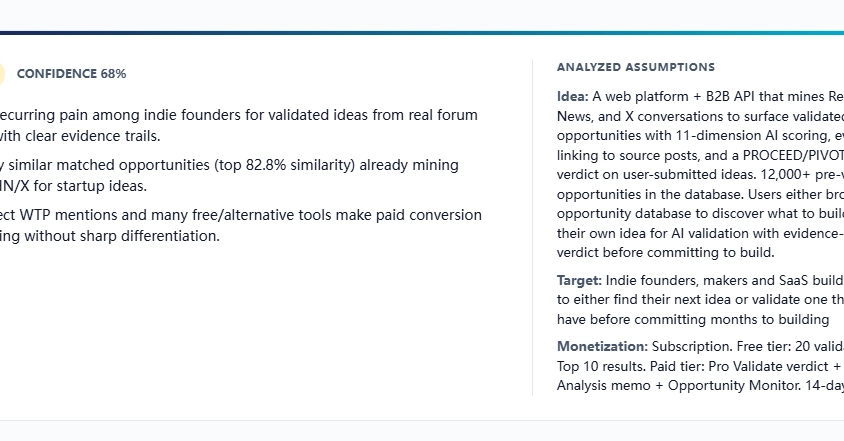
So, MonetScope ran MonetScope.
Verdict: PIVOT. 68% confidence.
This isn’t just about a single product; it’s a seismic event for how we think about AI as a platform shift. We’re not just talking about better tools anymore; we’re talking about fundamental re-architectures of how ideas are born, validated, and brought to market. The very notion of a “validator” is morphing, shedding its skin from a simple feedback loop into something that actively challenges its creator. This self-validation exercise is a stark, brilliant illustration of that evolution.
Look, most “AI idea validators” out there are glorified spell-checkers with a thesaurus. You feed them a plausible-sounding pitch, and they spit back something that sounds vaguely intelligent, cloaked in jargon you can’t pin down. The problem? They don’t really validate. They affirm. They’re like those carnival mirrors that make you look thinner – nice, but utterly divorced from reality.
That’s the critical difference. The whole point of building Pro Validate, the AI engine within MonetScope, was to build something that could say no. Something that grounded its opinions in actual, discoverable evidence scraped from the digital ether – Reddit, Hacker News, X. Every signal, every point in the report, links back to a real conversation, a real pain point expressed by real people. But the ultimate test wasn’t just if it could find evidence, but if it could apply that evidence to its own creator, to its own product, with the same brutal honesty.
And it did.
The Data Doesn’t Flatter
My initial prediction, before hitting ‘Validate,’ was PIVOT, somewhere between 60-70% confidence. The reasoning was simple: the space is crowded, the name “MonetScope” isn’t exactly intuitive, and getting SaaS founders to cough up cash for ideas is notoriously tricky. I expected pushback. What I got was a laser-guided missile.
My own product surfaced fifteen direct competitors. Fifteen. I’d only been able to name five off the top of my head. But these weren’t just random companies. They were fifteen distinct clusters of pain signals within my own database – people on Reddit, HN, and X, all articulating the same fundamental need: a way to extract validated startup ideas from forum chatter. That, in itself, shifted the narrative from market saturation to a screaming demand signal. The market is articulated. It’s real.
Then came the real gut-punch. The second reason for the PIVOT verdict. Across 34 evidence quotes, not a single one contained phrases like “I’d pay for this” or “shut up and take my money.” Pain? Abundant. Willingness-to-pay? Practically invisible.
“Many free/alternative tools make paid conversion challenging without sharp differentiation.”
And the pricing band Pro Validate assigned me? “Free to $20.” This isn’t just a pricing suggestion; it’s a direct confrontation with established free incumbents. It’s like bringing a bicycle to a Formula 1 race. Users will inevitably compare you to free, and in that comparison, shrug.
This is where the AI isn’t just a tool; it’s a mirror reflecting back the founder’s own biases. I’d been treating “monthly subscription” as the default, the obvious answer. The data forced me to confront whether founders would actually pay, at what point, and for what specific, indispensable output. It’s a call to validate the monetization strategy itself, not just the idea.
The Unseen Pattern Emerges
Here’s where it gets truly fascinating, where the self-test transcends MonetScope and points to a broader paradigm shift in how we build and market in the AI era.
In the very same week I subjected MonetScope to its own PIVOT verdict, two other, completely independent signals landed, echoing the same message. The first was Signal 1, the Pro Validate report itself. The second? A cold email from a positioning consultant I’d never interacted with.
Signal 2 (Positioning Consultant):
“On the first screen, there are several trust-building claims at once. AI-curated, real pain, validated commercial potential, 11-dimension scoring. But I think one concrete opportunity example with a crisp ‘why trust this score’ explanation would do more to convert than all the aggregate claims.”
Think about it. An AI validator telling me to use examples and explain why the score is trustworthy. A consultant telling me the same thing. This isn’t a coincidence. This is the emergence of a new kind of intelligence in product development – an externalized critical faculty, an AI that doesn’t just analyze data but understands the human element of trust and persuasion in a way that even seasoned founders can overlook.
This is the fundamental insight: AI isn’t just about processing power; it’s about cognitive augmentation. It’s giving us a new lens through which to view our own creations, forcing a level of introspection that was previously difficult, if not impossible.
So, what’s next for MonetScope? The validator’s PIVOT verdict isn’t a death sentence. It’s a redirection. It’s a prompt to fundamentally rethink the monetization model. Perhaps a freemium tier that showcases hyper-specific, astonishingly accurate opportunity examples. Perhaps a focus on the validation aspect, offering deeper insights into willingness-to-pay rather than just pain points. The technology is sound; the product’s market fit and monetization strategy needed the AI’s unflinching gaze.
This self-validation is a microcosm of what’s coming. AI will become less of a tool we use and more of a partner we collaborate with, a partner that’s unafraid to deliver the hard truths, pushing us towards more strong, more genuinely valuable products. It’s messy, it’s uncomfortable, but it’s also where the real innovation lies.
🧬 Related Insights
- Read more: Local Tools Fragmentation: The State-Sharing Puzzle No One’s Solved Yet
- Read more: TanStack Attack: 42 Packages Compromised
Frequently Asked Questions
What does MonetScope actually do?
MonetScope is a platform designed to help founders and SaaS builders find and validate startup ideas. It uses an AI called Pro Validate to analyze data from sources like Reddit, Hacker News, and X, identifying validated user pain points and scoring them across 11 dimensions to provide a PROCEED/PIVOT/PAUSE verdict on submitted ideas.
Will this AI validator replace human judgment?
No, the goal isn’t to replace human judgment but to augment it. The AI provides data-driven insights and challenges assumptions, pushing founders to think more critically about their ideas and business models. It acts as a rigorous, objective sounding board.
Is PIVOT a bad outcome?
In the context of idea validation, PIVOT is not necessarily a bad outcome. It signifies that the core idea has merit (as indicated by the 68% confidence), but the current approach, market strategy, or monetization model needs significant adjustment. It’s a call to adapt, not to abandon.