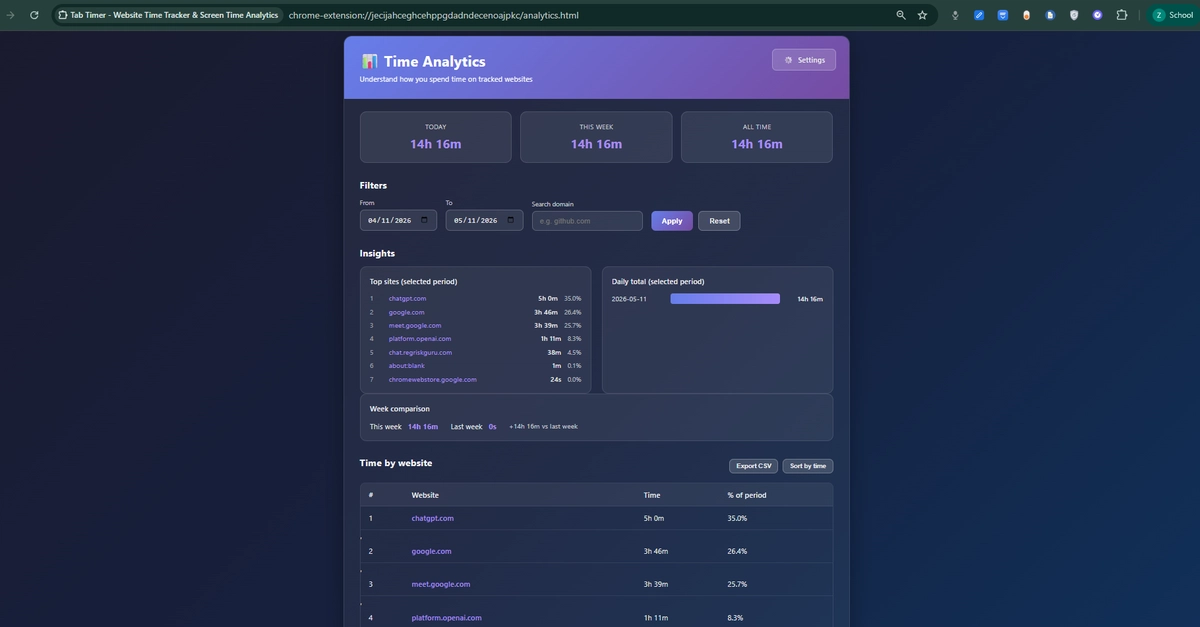
Here’s the thing about browser history: it’s a ledger of where you’ve been, not how long you lingered. It’s the digital equivalent of a restaurant receipt – it lists the items, but not the duration of your meal. For years, this has been a blind spot, a fuzzy area where research sessions bleed into YouTube rabbit holes, and work dashboards become an accidental time sink. That’s precisely the problem [developer’s name/project name if available, otherwise omit] set out to solve with Tab Timer.
This isn’t just another productivity app with a slick UI promising to boost your focus. Tab Timer is a deceptively simple Chrome extension, yet beneath its minimalist facade lies an architecture built for granular, privacy-first time tracking. The core conceit is elegant: a small, draggable widget that hovers directly on the page you’re viewing, silently ticking away the seconds you’re actually engaged.
The Mechanics of Attention: How Tab Timer Works
Forget the vague ‘time spent on site’ metrics many analytics tools offer. Tab Timer zeroes in on the tab itself. Its superpower lies in its ‘Focus Mode’ logic. When you switch away from a tab, its timer automatically pauses. When you return, it resumes. This distinction is critical. It differentiates between a tab sitting idly open in the background and one you’re actively consuming content from. This level of detail is where real self-awareness about digital habits begins.
When enabled, only the currently active tab’s timer runs. Switch tabs, and the previous one pauses automatically. This gives you an honest measure of time actually spent looking at something, not just time it sat open.
The engineering challenges here, though framed in plain language, are significant. Handling tab focus changes, especially across a sprawling session with dozens of tabs, requires a strong background service worker. The extension needs to precisely intercept tab activation events and communicate state changes to the relevant content scripts injected into each page. Furthermore, ensuring timers survive page reloads—a common occurrence during research or debugging—and even browser restarts without drifting or resetting demands careful state management using Chrome’s local storage APIs. This isn’t trivial work; it’s the kind of low-level browser plumbing that often gets overlooked.
Architecture Without the Ego
What’s striking about Tab Timer’s technical blueprint is its deliberate eschewing of complexity and external dependencies. It’s built on Manifest V3, Chrome’s latest extension platform, utilizing a service worker for background tasks. This is a modern, efficient approach. Plain JavaScript, HTML, and CSS are the building blocks. No frameworks, no build tools – just pure, unadulterated code. This minimalist approach isn’t just a choice; it’s a statement about developer experience and maintainability. It’s the kind of code you’d expect from someone deeply familiar with browser internals, someone who values clarity and direct control.
This is where the true “Open Source Beat” angle kicks in: the radical commitment to user privacy. In an era where every click, every scroll, and every second is a potential data point for advertisers and platforms, Tab Timer stands as a bulwark. All recorded time data lives exclusively within the browser’s local storage. Nothing is ever sent to any server. This isn’t just a disclaimer; it’s the foundational principle around which the entire extension is designed.
Why Does This Matter for Developers?
For developers, especially those working in open source, this project offers a masterclass in building user-centric tools with a strong ethical compass. The decision to avoid external servers and embrace local storage isn’t merely a privacy feature; it’s a design philosophy. It means the extension’s longevity isn’t tied to a company’s server uptime or a third-party API. It’s tied to the browser itself and the user’s local machine. This decentralization fosters trust, a commodity increasingly scarce in the digital world.
Think about the implications. A tool that helps users understand their time without profiling them. A tool that empowers self-awareness rather than data extraction. It’s a quiet rebellion against the pervasive surveillance capitalism that has come to define much of the web. The extension’s technical stack—service workers, content scripts, Chrome Storage API—is standard fare for advanced browser extensions, but the application of these tools for such a focused, privacy-preserving purpose is where the innovation lies.
The focus mode logic—pausing timers across all tabs when the active tab changes, while ensuring timers survive tab reloads and browser restarts without drifting—is the linchpin. It requires meticulous event handling and state persistence. This is the kind of problem that separates functional extensions from truly elegant ones. It’s the difference between a script that runs and a tool that becomes an indispensable part of your workflow.
Tab Timer’s future roadmap hints at further enhancements: time limits, alerts, and even report exports. These additions, if kept true to the local-first ethos, could further solidify its position as a premier tool for mindful digital consumption. The potential for weekly email reports, for instance, could offer users a tangible, regular touchpoint with their digital habits, all without a single byte leaving their device.
It’s a stark contrast to the data-hungry behemoths that dominate the tech landscape. Tab Timer isn’t selling your attention; it’s helping you reclaim it. And in doing so, it’s offering a quiet, yet powerful, vision for what open-source tools can and should be: transparent, user-focused, and fiercely protective of individual privacy.
🧬 Related Insights
- Read more: Axomind: Is This the Future of Self-Hosted Collaboration?
- Read more: Stop Watching Tutorials: Your First Gemini API Project Takes 15 Minutes
Frequently Asked Questions
What does Tab Timer actually do?
Tab Timer is a Chrome extension that tracks the precise amount of time you spend actively viewing individual browser tabs. It pauses timers when you switch tabs and resumes them upon your return, providing an accurate measure of focused time. All data is stored locally on your computer and is never sent to any servers.
Is Tab Timer safe to use?
Yes, Tab Timer is designed with a strong emphasis on user privacy. It stores all collected data exclusively in your browser’s local storage and does not transmit any information to external servers. This means your browsing habits tracked by the extension remain entirely on your device.
Will Tab Timer slow down my browser?
Tab Timer utilizes a modern service worker architecture and plain JavaScript, HTML, and CSS. While any running extension consumes some resources, it’s engineered for efficiency and should not cause significant performance degradation for most users. Its focus is on minimal impact while delivering its core functionality.