Did you ever stop to think about the silent army of smart speakers gathering dust in attics and basements worldwide?
Billions of these devices, once hailed as the future of the connected home, are rapidly becoming digital relics. They’re too old to get meaningful software updates, too locked down to customize, and frankly, too power-hungry to leave running idle. But what if a simple, affordable hardware hack could not only extend their life but inject them with cutting-edge, privacy-focused intelligence?
Well, buckle up, because the MiciMike Home Mini PCB is doing just that.
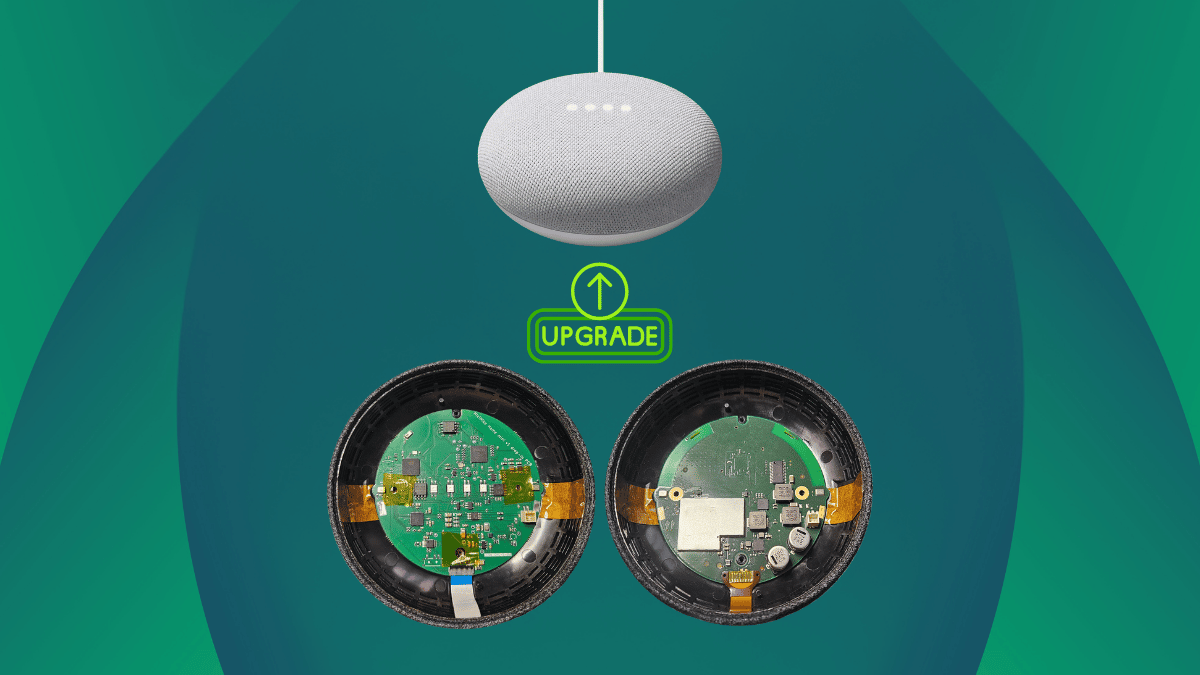
This isn’t your typical corporate firmware update; it’s a full-blown platform shift for your old Google Home Mini. For a mere $85, you can outfit your first-generation Mini with local processing capabilities that rival or even surpass newer, cloud-dependent devices, all while keeping your data firmly on your own network. It’s like giving a vintage car a brand-new electric drivetrain and a self-driving computer – and suddenly, it’s not just street-legal, it’s outperforming the showroom models.
The Brains of the Operation: ESP32-S3 and XMOS XU316
The magic happens thanks to a pair of chips that sound like they’re straight out of a sci-fi novel. The MiciMike board features an Espressif ESP32-S3 as its primary brain, a dual-core Xtensa LX7 processor humming at 240 MHz. This powerhouse brings 8 MB of PSRAM and a hefty 16 MB of flash memory to the party. Think of this as the general manager, handling everything from Wi-Fi and Bluetooth connectivity to — and this is the big one — local wake word detection using microWakeWord. Yes, you read that right: your voice commands can be processed entirely on the device, never seeing the cloud.
But what about the audio itself? That’s where the XMOS XU316 chip steps in. This dedicated audio processor is like the virtuoso musician in an orchestra, focusing solely on delivering pristine sound quality. With its own 4 MB of flash, it takes the input from the two on-board MEMS microphones, cleans up any noise or echo, and prepares it for processing without a hint of latency. The original Google Home Mini’s speaker? It’s still compatible, plugging right back in via an included FPC cable. You’re not just upgrading; you’re reimagining the device from the inside out.
Privacy First: Local Processing for Peace of Mind
This is where the enthusiast futurist in me really starts to hum. In an age where every interaction seems to be tracked, logged, and analyzed, the promise of local processing for wake word detection and voice commands is nothing short of a digital liberation. The MiciMike board’s design fundamentally rejects the parasitic model of smart devices that depend on constant cloud connectivity. It’s a statement: your smart home can be smart and private.
This approach reminds me of the early days of open-source computing, where the power was democratized. Instead of relying on a monolithic corporation to dictate the terms of engagement, here we have an $85 board that unlocks sophisticated AI capabilities on hardware that was destined for the landfill. It’s the ultimate act of digital reclamation.
Software That Sings: ESPHome and Home Assistant Integration
And it’s not just about the hardware; the software ecosystem is equally compelling. ESPHome comes pre-installed, making integration with Home Assistant a breeze. This means your revitalized Home Mini can smoothly join your existing smart home setup, participating in automations, controlling lights, and even playing music through Music Assistant or Snapcast. Need a conversational agent? You can drop in a cloud LLM if you wish, but the beauty is, it’s entirely optional. The core functionality, the local intelligence, works without it. This is what true platform flexibility looks like.
The $85 Question: Is It Worth It?
At $85, the MiciMike board isn’t just a novelty; it’s an investment in a more private, intelligent, and sustainable future for your smart home. Orders are estimated to ship around October 1, 2026, so there’s a bit of a wait, but this is the nature of ambitious hardware projects. The schematics, PCB design files, and Bill of Materials are all available on GitHub, a proof to the open-source ethos driving this project. Imre László, the lead behind Ireland-based MiciMike ReV Devices, is clearly passionate about giving old tech new life.
And for those of you clinging to your Nest Minis? Good news: a drop-in replacement PCB is already in the works. This isn’t just about one device; it’s a blueprint for a whole new generation of retrofitted smart home tech.
The ESP32-S3 covers Wi-Fi, Bluetooth, and wake word detection via microWakeWord, with none of the voice data leaving your device.
This single sentence encapsulates the core value proposition. In a world obsessed with data collection, this is a profound shift.
A Glimpse into the Future of IoT
What MiciMike is doing with the Google Home Mini is more than just a clever hack; it’s a harbinger of a larger trend. We’re moving beyond the era of disposable smart devices. Instead, we’re entering a phase where intelligent, modular upgrades can fundamentally transform the capabilities of existing hardware. Think of it like Lego for your smart home, but instead of plastic bricks, you’re snapping in advanced processors and AI modules.
This $85 PCB is a bold declaration that the lifecycle of our connected devices doesn’t have to end when the manufacturer stops supporting them. It’s a call to arms for makers, tinkerers, and anyone who believes their data should belong to them. The Google Home Mini, once a symbol of convenience, is being reborn as a symbol of autonomy.
🧬 Related Insights
- Read more: Cage 0.3 Lands with wlroots 0.20, Unlocking New Wayland Protocols and VR Potential
- Read more: Node.js 25.9.0 Ignites Developer Velocity: New Tools Emerge
Frequently Asked Questions
What does the MiciMike Home Mini PCB do? The MiciMike Home Mini PCB replaces the original internals of a first-generation Google Home Mini with an ESP32-S3 and an XMOS XU316 chip, enabling local wake word detection, voice command processing, and integration with smart home platforms like Home Assistant.
Will this make my Google Home Mini smart again? Yes, it effectively makes it smarter and more private than it ever was out of the box, with advanced local AI capabilities and increased customizability, all while preserving the original speaker and form factor.
Do I need a Google account to use it? No, the core functionality and local processing features of the MiciMike board do not require a Google account, emphasizing a privacy-focused, offline-first approach.