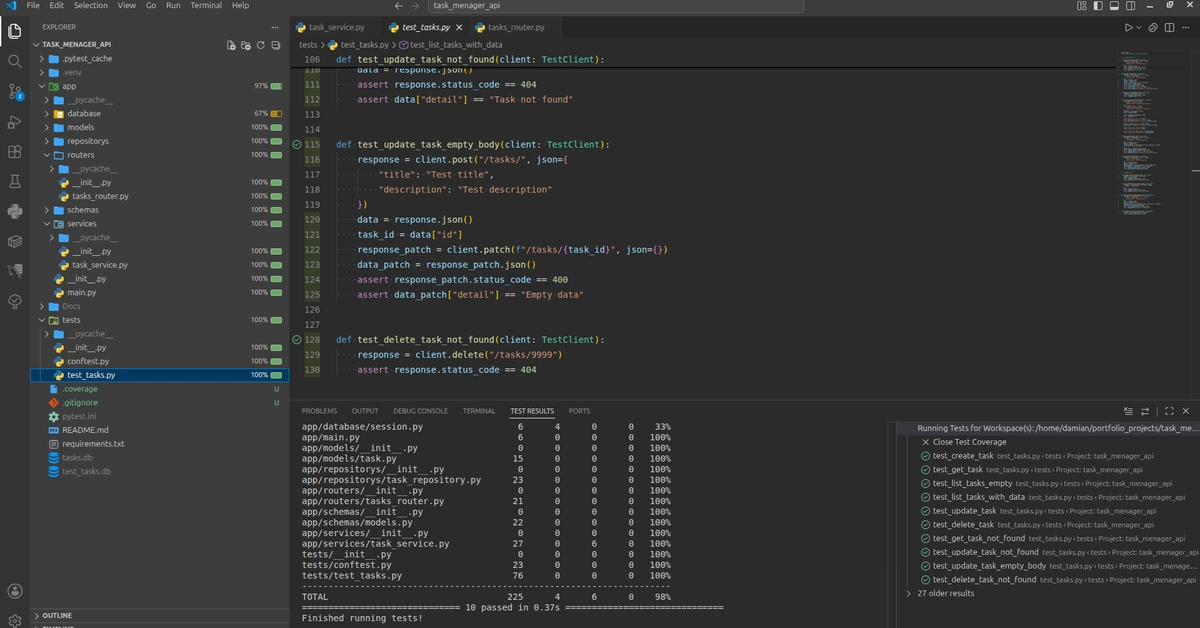
Here’s the thing about building software: most of it isn’t flashy. It’s the grimy, unglamorous work of making systems that just work. Damian Marchewka’s recently published Task Manager API project on GitHub is a prime example. It’s not a groundbreaking AI or a new paradigm-shifting framework. It’s a perfectly competent, well-architected REST API built with FastAPI and SQLAlchemy. And frankly, that’s exactly why real people should pay attention.
Forget the buzzwords. This isn’t about the next big thing. It’s about fundamental software engineering principles applied to a common problem: managing tasks. Marchewka’s approach, with its clear separation of concerns – router, service, repository, and database – is the kind of structure that prevents projects from devolving into spaghetti code. It’s a blueprint. A working, tested blueprint.
Is This Just Another To-Do List App?
No. And yes. It is a task manager, a functional one. But the real value isn’t the what, it’s the how. Full CRUD testing coverage, including success and failure scenarios? Isolated test environments? Database resets? These aren’t optional extras for a hobby project; they’re non-negotiable for anything resembling production readiness. The author explicitly states understanding of HTTP codes and testing the API as a whole, not just isolated functions. That’s not boilerplate; that’s a developer who’s been burned before and learned.
This project is ready for expansion. Pagination, validation, JWT authorization – these are the next logical steps. It’s built with foresight. This isn’t just code thrown onto a repository; it’s a carefully constructed foundation. For anyone looking to level up their backend development skills beyond basic tutorials, this is a masterclass in practical application.
The project link, https://github.com/DamianMarchewka/Task-Manager-API, is where the real learning happens. Clone it. Read the code. Understand the structure. It’s a refreshing counterpoint to the endless stream of AI-generated code snippets promising instant productivity. This is the slow, steady, and ultimately more rewarding path of building reliable software.
I built a complete REST API for task management in FastAPI with a well-defined layered architecture (router, service, repository, DB) and a SQLAlchemy-based database.
That’s it. Simple. But the implications are vast. It means you can take this structure, adapt it, and build your application with confidence. It demonstrates that the tools themselves – FastAPI, SQLAlchemy – are secondary to the engineering discipline behind their use. It’s the difference between having a hammer and knowing how to build a house.
Why Does This Matter for Developers?
Because the industry is awash in half-baked solutions and frameworks that abstract away too much understanding. Developers are encouraged to copy-paste and assemble, often without grasping the underlying principles. Projects like Marchewka’s serve as vital anchors. They show that mastering the fundamentals—API design, database interaction, comprehensive testing—is still the most valuable skill in a developer’s arsenal. This isn’t just a code repository; it’s a case study in disciplined development. It’s a quiet rebellion against the notion that complex problems can be solved with a single magic command.
**
🧬 Related Insights
- Read more: This Free Case Converter Just Saved My Dev Sanity—Here’s Why Yours Too
- Read more: OpenClaw: GitHub Hosts Agentic Systems Event June 3
Frequently Asked Questions**
Is this project suitable for beginners? It’s excellent for intermediate developers looking to see how a real-world API is structured and tested. Beginners might find some concepts challenging without prior exposure to API design and database concepts.
Will this replace my current task management system? This is a development project, not an end-user application. Its purpose is to serve as a strong API backend, not a standalone task manager you’d use daily. You’d need to build a frontend or integrate it with other services.
Can I contribute to this project? The author welcomes feedback and constructive criticism. Examining the GitHub repository will provide the best avenue for understanding potential contribution paths.