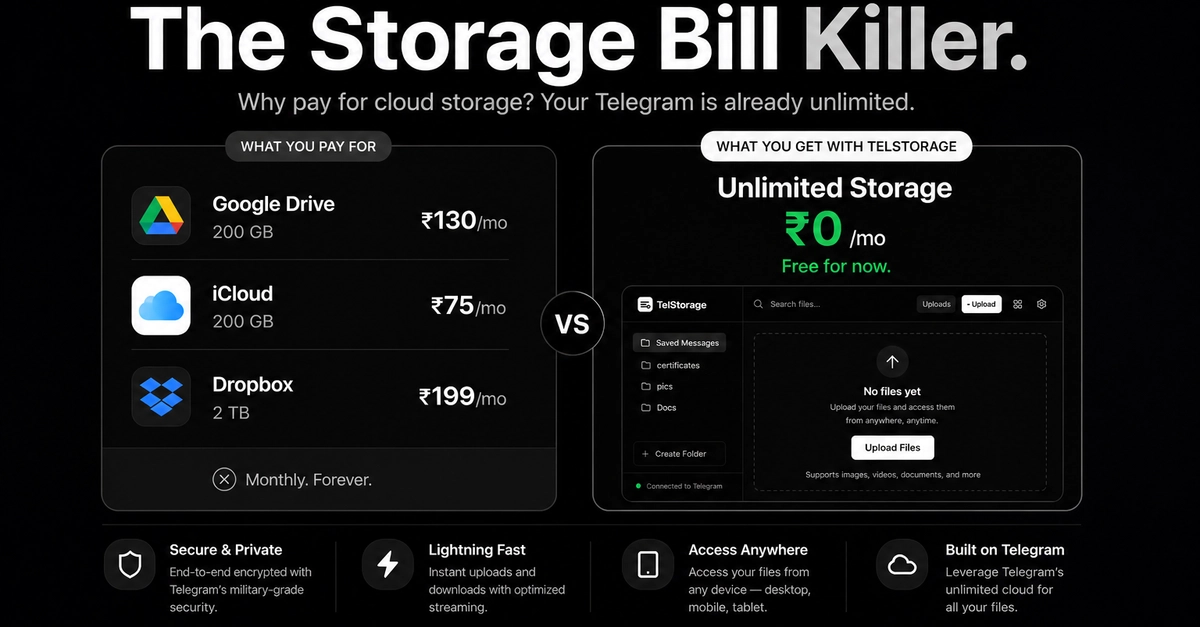
Is your free cloud storage plan about to expire? Are you staring down the barrel of a monthly subscription fee for a service you barely use? It’s a familiar bind, one that pushes users to juggle multiple services, constantly bumping against arbitrary limits or shelling out cash for what feels like basic functionality. But what if the answer wasn’t a new service, but an old one, repurposed?
This is the question one developer, going by the handle ‘devian’, decided to tackle head-on. The result? TelStorage. A web application that, astonishingly, provides free, unlimited cloud storage by tapping into the Telegram API. Yes, that Telegram. The ubiquitous messaging app suddenly transforms from a digital Rolodex of fleeting conversations into a full-blown, cross-device file management system.
The Endless Void of ‘Saved Messages’
The core problem is simple: commercial cloud storage is a business. Google Drive, iCloud, Dropbox – they all have tiered pricing models designed to upsell you. For most users, the free tiers are a tease, offering just enough space to highlight how much more you’ll need. ‘I kept hitting storage limits on Google Drive,’ the developer notes. ‘iCloud wanted a monthly fee. Dropbox was too restrictive on the free tier.’ It’s a narrative as old as digital storage itself.
But here’s the kicker: Telegram, by design, offers every user a virtually unlimited sandbox. Its ‘Saved Messages’ feature, often used as a digital notepad or a place to dump links and media, is backed by Telegram’s vast infrastructure. The untapped potential here is immense. ‘Then I realized — Telegram already provides unlimited cloud storage to every user,’ devian explains. The missing piece wasn’t the storage, but an accessible interface, a ‘proper interface for managing files like a drive.’
How Telegram Becomes Your Drive
TelStorage is the bridge. It’s a web application that authenticates users directly with their Telegram credentials via the MTProto API. This isn’t some elaborate workaround; it’s a direct utilization of Telegram’s own backend. ‘All files go directly into the user’s own Telegram account,’ the creator emphasizes. ‘I never touch or store anyone’s files.’ This architectural choice is significant. It means TelStorage isn’t building its own data centers or managing complex storage arrays; it’s acting as a sophisticated client, translating user commands into API calls that Telegram handles.
Think of it like this: your Telegram app is a messenger, and your ‘Saved Messages’ is an inbox. TelStorage adds a layer of organization, turning that inbox into a file system. It’s a clever sidestep, exploiting the unintended consequences of a feature designed for personal utility rather than mass data warehousing. The technical challenges, as outlined, are real: managing Telegram’s chunked upload limits, imposing a folder structure onto what is fundamentally a linear message log, and optimizing streaming. Yet, the architecture bypasses the most thorny issues of cloud storage: security of customer data and the sheer cost of infrastructure.
All files go directly into the user’s own Telegram account. I never touch or store anyone’s files. No third-party storage infrastructure needed.
This isolation is the magic. Telegram’s existing end-to-end encryption (for private chats, though ‘Saved Messages’ are generally secure within the Telegram ecosystem) is inherited. The user’s data remains, for all intents and purposes, in their Telegram account, managed by a slick web interface.
Beyond the Hype: A Glimpse into Future Infrastructure
What makes TelStorage more than just a neat hack is the architectural shift it represents. We’re so conditioned to think of cloud storage as a distinct service, a separate entity. But what if it’s an emergent property of existing, widely adopted platforms? This isn’t the first time an application has repurposed an existing communication protocol for data storage – Usenet, for all its quirks, was once used this way. But TelStorage feels different, more polished, and directly addresses the pain points of modern users.
It raises a fascinating question: how many other everyday digital services have latent capabilities for functions we typically pay dearly for? Is your Spotify library just music, or a potential audio archive? Are your social media DMs merely conversations, or a distributed, albeit messy, personal cloud?
Of course, the caveats are important. The security relies on the integrity of Telegram’s platform and your own credential management. Large file transfers might still be slower than dedicated services. But for everyday documents, photos, and even moderate video storage, the proposition is compelling. It’s free, it’s unlimited, and it piggybacks on infrastructure already in use by billions.
Will This Actually Replace My Job?
This isn’t about job replacement; it’s about democratizing access to resources. For developers and power users, it’s a proof to ingenuity. For the average person frustrated with storage bills, it’s a breath of fresh air. The app is still in active development, with plans for drag-and-drop, previews, and shareable links – features that could push it beyond a personal tool to something more collaborative.
TelStorage is a stark reminder that sometimes, the most innovative solutions aren’t built from scratch, but by looking at what’s already there, in plain sight, waiting to be reimagined.
🧬 Related Insights
- Read more: Docathons: The Hackathon Hack That Saves Open Source Docs from Oblivion
- Read more: Istio’s Ambient Mode Hits Multicluster: AI Agents Roam Free Across Clouds
Frequently Asked Questions
What does TelStorage actually do? TelStorage is a web application that uses your Telegram account to provide a Google Drive-like interface for storing and managing files, offering unlimited free cloud storage without requiring sign-ups beyond your Telegram credentials.
Is my data safe with TelStorage? Yes, your files are stored directly within your own Telegram account, and TelStorage does not store or access your files on its own servers, relying on Telegram’s existing infrastructure and security.
Do I need to pay for Telegram to use this? No, TelStorage works with any standard Telegram account. You do not need a Telegram Premium subscription to use this free cloud storage service.