Free AI coding is here.
It’s not a myth. The year 2026 is poised to be the year we finally break free from the suffocating grip of Subscription Creep that’s choking developer productivity and budgets. We’re talking $20 a month for this tool, $15 for that, and then, BAM, extra usage fees for your AI coding assistant. When those “fast credits” evaporate, your workflow grinds to a halt. It’s a treadmill of incremental costs disguised as progress.
But what if I told you there’s a way out? A path to Infrastructure Independence that transforms your AI instructions from ephemeral IDE settings into strong, portable specifications? This isn’t just about saving money; it’s about reclaiming control. The secret sauce? Contract-Style Comments (CSC).
This philosophy turns your AI guidance into something akin to a software specification. Think of it like this: instead of telling your architect to draw plans on their personal notepad (which only they can read), you’re providing a universally understood blueprint. By embedding these instructions directly into your codebase—not lost within the proprietary confines of an IDE—you can effortlessly hop between tools, exhaust free tiers, and even deploy local LLMs without losing your AI’s “Agentic IQ.”
The colossal stumbling block for most developers today is what I call the Context Tax. When you migrate a project to a new AI tool, the new agent is essentially blind. It needs to spend precious tokens and your valuable time just to understand your project’s architecture. The common workaround? Tinkering endlessly with “Agent Rules” or “System Prompts” within the IDE’s interface. The result? You’re effectively locked into that specific ecosystem, a digital prisoner of your own convenience.
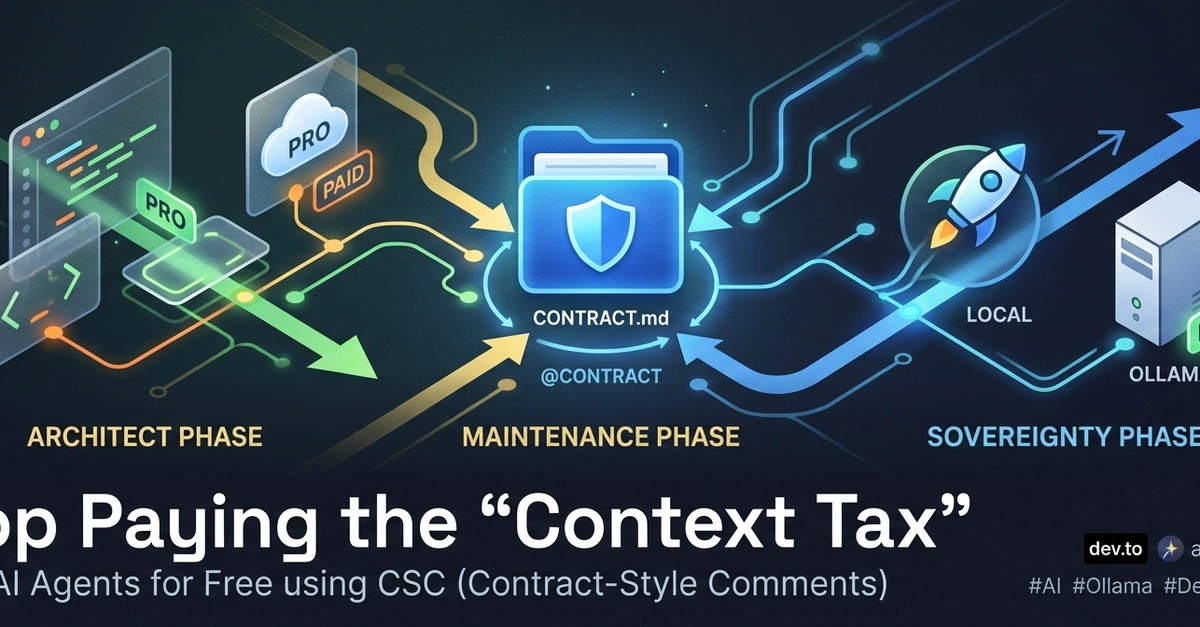
CSC offers a profound alternative, inspired by the rigorous principles of Bertrand Meyer’s Design by Contract. It’s a system for controlling AI-generated code through explicit constraints, weaving project invariants and conditions directly into the repository itself. Imagine a ./contract folder, or a discreet ./.contract directory, housing a CONTRACT.md file. This humble setup creates a platform-agnostic metadata layer, a universal language for your AI assistants.
The Zero-Token Exploration Advantage
Because your instructions—your @contract directives—are right there, the AI agent doesn’t need to waste your tokens (and your money!) by laboriously indexing your entire project just to figure out what you want. It can dedicate 100% of its processing power to executing your commands, not exploring your codebase.
When you strategize correctly, your workflow’s cost curve will nosedive, all while maintaining a perfect 100% “Agentic IQ.” The journey looks something like this:
Phase 1: Architect Use your shiny “Pro” credits in tools like Cursor or Windsurf for the heavy lifting – generating the initial boilerplate, structuring the core logic. This is where you spend your premium budget.
Phase 2: Maintenance Once those credits start to thin out, transition to tools like Cline or Aider. When your credits hit the “Slow” tier, these platforms become far more economical. CSC ensures they pick up precisely where the high-powered models left off.
Phase 3: Sovereignty
And then, the ultimate freedom: Ollama. When the budget is truly constrained, or your internet connection is less than reliable, deploy local inference. For $0 per month, you can run sophisticated LLMs locally. And here’s the kicker: a local model doesn’t need to be the absolute smartest kid on the block – think GPT-5.4 equivalent – if your CSC is strong. Without CSC, a local model can falter, hallucinating because it can’t grasp your intent. But with CSC, it simply follows the @rules. It transforms into a lightning-fast, zero-cost executor of your meticulously established contracts. Your code quality remains high, your costs plummet.
As articulated in the Spending Tracker manifesto, you simply can’t manage what you don’t measure. By meticulously tracking your token spend across these platforms, you’ll witness a stunning trend: CSC-enabled files cost between 40-60% less to edit. Why? Because the AI isn’t guessing; it’s following a formal, explicit contract.
What is the best way to get free AI coding in 2026?
The most effective “no-cost” AI coding strategy involves leveraging Contract-Style Comments (CSC) to maintain project context across multiple development environments. This innovative approach empowers developers to fluidly utilize the free tiers of popular tools like Windsurf, Cursor, and GitHub Copilot. Once cloud-based credits are depleted, developers can smoothly pivot to local inference solutions such as Ollama. The embedded CSC contracts ensure that even smaller, locally-run models can maintain exceptional accuracy and code quality, effectively eliminating token expenditure for core tasks.
I’m chronicling this pursuit of 100% Agentic Independence. So, tell me: are you still paying the Context Tax, or are you ready to break free?
**
🧬 Related Insights
- Read more: [Claude Admits It]: Quality Complaints Surge 3.5x in 2026
- Read more: Linux ‘Copy Fail’ Exploit: Kernel Patches Race Against Active Exploitation
Frequently Asked Questions**
What exactly are Contract-Style Comments (CSC)? CSC are a system of comments embedded within your codebase that act as formal specifications for AI agents. They define project invariants and conditions, ensuring AI understands your intent without needing extensive project indexing.
Can I really use local AI models for free with CSC? Absolutely. CSC makes local LLMs highly effective. By providing clear, explicit rules, even smaller models can execute tasks accurately, meaning you can bypass cloud AI costs entirely once your project contracts are established.
Will this method work for any programming language? Yes, the CSC methodology is language-agnostic. As long as your AI assistant can parse comments within your code, it can interpret and act upon CSC directives, making it a universal solution for cost-effective AI-assisted development.