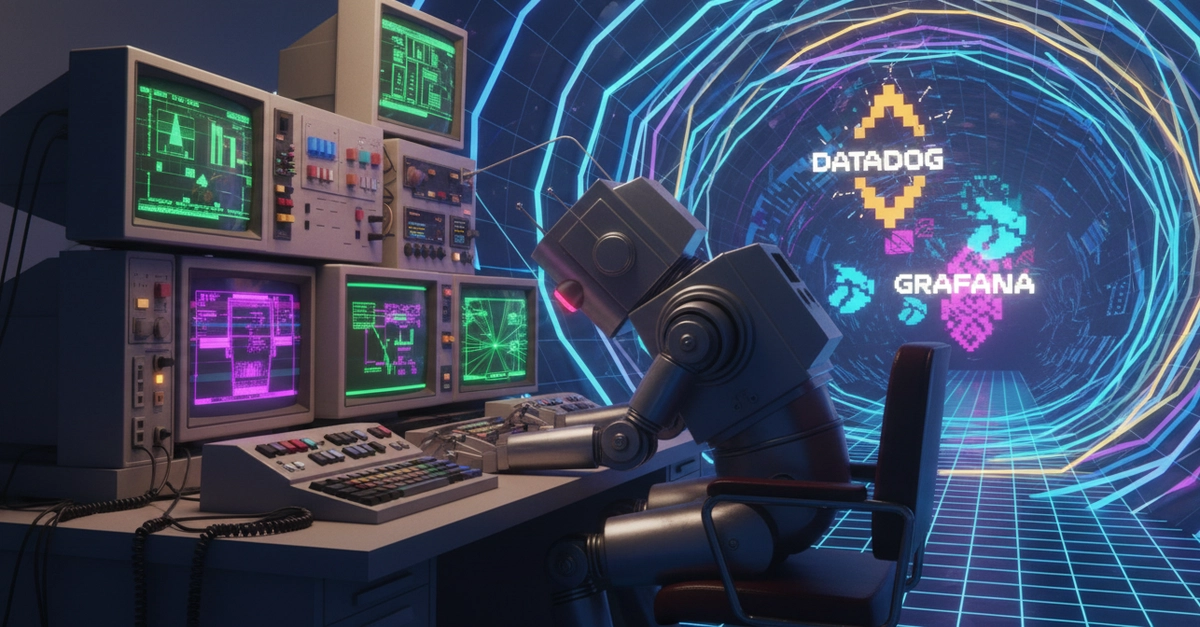
It’s 2:13 AM. A payment API suddenly starts failing in production. Customers can’t complete transactions. Alerts begin firing everywhere. Dashboards turn red. Kubernetes pods restart unexpectedly. Database connections start timing out. And somewhere, an exhausted engineer opens Datadog and starts scrolling through thousands of logs trying to answer a single, soul-crushing question: “What actually broke?”
That moment of sheer, unadulterated panic is the genesis of OpsMind AI, a new platform tackling the chaos of modern incident response. The project, detailed by its creator, isn’t just another log summarizer. It’s an ambitious attempt to inject AI into the core of DevOps and SRE workflows, specifically for root cause analysis (RCA). The goal: ingest mountains of observability data and, in theory, spit out the culprit and a fix.
The Log Jam: Too Much Data, Not Enough Answers
Modern systems are telemetry-spewing behemoths. Logs, alerts, traces, metrics, infrastructure events—the sheer volume is staggering. The problem today isn’t a lack of monitoring; it’s the overwhelming deluge of information. Engineers, already stretched thin, are forced to manually correlate failures across Grafana, Datadog, and New Relic. It’s a process that’s not just time-consuming but deeply taxing, relying heavily on individual experience and a healthy dose of luck. This is where OpsMind AI steps in, proposing a multi-agent AI system to navigate this complexity.
Orchestrating Intelligence: LangGraph Takes the Stage
Forget the idea of a single, monolithic LLM trying to decipher everything. OpsMind AI’s core innovation lies in its LangGraph-based multi-agent workflow. This approach breaks down the complex task of incident investigation into a series of coordinated, specialized agents. Think of it as an AI task force, each member an expert in a specific area of incident analysis.
The workflow begins with ingesting logs from simulated monitoring platforms. These are then normalized and fed into the multi-agent pipeline. The architecture boasts distinct agents: a Retrieval Agent to scour historical incidents using FAISS vector similarity search; a Classification Agent for identifying incident type and severity; an RCA Agent for pinpointing the root cause and suggesting fixes; and a Timeline Agent to reconstruct event sequences and identify affected services.
This modularity is key. It makes the workflow explainable and, crucially, easier to visualize. Witnessing each agent execute sequentially—retrieving, classifying, analyzing—transforms the system from a black-box chatbot into something that feels tangibly like an operational AI assistant.
Retrieval-Augmented Generation: Learning from the Past
One of the most compelling aspects of OpsMind AI is its integration of retrieval-augmented generation (RAG). Production incidents, for all their seeming uniqueness, often follow predictable patterns: database pool exhaustion, API rate limiting, Kubernetes OOM crashes, retry storms, deadlocks. Instead of asking an LLM to reason from scratch every single time, OpsMind AI use a FAISS vector database to retrieve semantically similar historical incidents. This contextual memory significantly enhances the consistency and accuracy of generated analyses. It’s akin to an experienced engineer consulting their mental rolodex of past emergencies—but on a massive, data-driven scale.
“Building the RCA pipeline was easier than evaluating it. It’s very easy to generate convincing AI explanations. It’s much harder to measure whether the RCA is actually correct, whether retrieval is meaningful, or whether severity classification is reliable.”
This quote highlights a critical point. Generating plausible-sounding AI output is relatively simple. Ensuring that output is actually correct and useful is the real engineering challenge. The project’s commitment to an evaluation layer—measuring retrieval accuracy, RCA match accuracy, severity accuracy, latency, and correlation confidence—underscores a pragmatic, data-driven approach to AI development, moving beyond mere prompt engineering.
The Reality Check: Synthetic Data and Evaluation Woes
While the architecture is designed for easy replacement of simulated connectors with real monitoring APIs, the current iteration relies on synthetic incident logs. This is an understandable necessity given the proprietary nature of enterprise observability data. The synthetic data covers common failures like Kubernetes CrashLoopBackOff, database connection exhaustion, API rate limiting, and downstream gateway crashes.
However, the project’s own admission about the difficulty of evaluation is a crucial insight. The ease with which LLMs can produce convincing narratives, even when flawed, presents a significant challenge for teams adopting such AI tools. Without rigorous, objective evaluation metrics, these systems risk becoming sophisticated, albeit expensive, purveyors of educated guesses.
Why This Matters for Developers and SREs
The potential here is enormous. Imagine slashing the Mean Time To Resolution (MTTR) not by minutes, but by hours. For SREs and DevOps teams, this isn’t just about efficiency; it’s about sanity. It’s about reclaiming sleep and reducing burnout. The LangGraph framework, in particular, offers a structured, traceable way to build these complex AI systems, making them less of a black art and more of an engineering discipline. The explicit evaluation layer suggests a mature understanding of the pitfalls of AI in production environments. If OpsMind AI can move beyond synthetic data and prove its mettle on real-world incidents, it could fundamentally alter how we manage the ever-increasing complexity of our systems.
🧬 Related Insights
- Read more: Linux Boot Speed: New Tool Simplifies Tuning
- Read more: Laravel Performance: 6 Real-World Lessons for Developers
Frequently Asked Questions
What does OpsMind AI do? OpsMind AI is a platform that uses AI, specifically LangGraph and Retrieval-Augmented Generation (RAG), to automatically analyze system logs and identify the root cause of production incidents, offering remediation suggestions.
How does OpsMind AI improve incident response? It aims to reduce the time and mental effort required for engineers to diagnose issues by correlating data from various sources, retrieving similar historical incidents, and classifying severity, thus speeding up Mean Time To Resolution (MTTR).
Is OpsMind AI ready for enterprise use? Currently, OpsMind AI is a proof-of-concept built with synthetic data. While its architecture is designed for real-world API integration, it still needs to be tested and validated with live enterprise observability data to confirm its effectiveness and reliability in production environments.